Thursday, June 11, 2009

Fitting In

Image from Motortrend

The recent proliferation of crossovers (cuvs, softroaders or whatever the hell you want to call them) has left me wondering about what their respective markets are? Until recently, I would have pitted the 2010 RX350 against its previous foes, the ML350, X5, MDX, and FX35. Recently, however it seems that major magazine has been pitting new smaller models against the RX. This leaves an interesting dilemma where it appears that new cuvs are displacing their fatter older siblings, providing customers with better handling vehicles for less money.
Take Mercedes for example. When you walk into a dealer, you have the choice of a GLK or the ML. Both only can accommodate five people; with the GLK being 10 inches shorter than the ML. In both packages, Mercedes serves the same v6 engine. The GLK is smaller but subjectively offers much better road presence and doesn't initially scream suburban housewife. Interior room does suffer, with the GLK giving up about 5 inches of legroom to the ML. Cargo volume also suffers by about 5 cubic feet. However, the big question is who is the ML supposed to compete with? The ML seems to get lost in the shuffle, its closest competitor is the FX, which is also offered in v6/v8 trim levels. Essentially, the problem is that when Mercedes created the new GL, they created a model that provided more space and allowed the new model to usurp the ML in their lineup. Now with the GLK, the ML really doesn't seem to have a place anymore.

BMW managed to save the X5 from having a similar identity crisis by endowing it with a vestigial rear seat. They also axed their full-size X7. It will be interesting to see how large BMW manages to make the new X3 and whether or not, it will now be viewed as an RX350 competitor as well.

While this has mainly been a meandering though experiment, Lexus should be able to capitalize by selling a boat-load of RX's or look to make another model. Right now, they lack a real performance CUV. This could be based off of the RWD platform that underpins the IS/GS. They could also look towards making a smaller CUV that could really compete and base something off the RAV4. Either way, Lexus looks like it is going to be able to continue its relentless pursuit of global luxury domination.

Saturday, February 14, 2009

Toyota Venza or RX350

If it were not for the badge discrepancy between the Venza and the RX350, I would have a hard time choosing the new RX350 over the Venza. Mechanically, in v6 trim both cars seem virtually identical. For the environmentally conscious, you can choose a 4-cylinder in the Toyota or a hybrid in the Lexus, and the money you save in the Toyota will more than offset the fuel savings potentially incurred into the hybrid.

For exterior styling, its a tossup. I think the Venza looks better overall whereas the Lexus looks kind of like a child going through through that middle school awkward phase. Certain areas are larger and more exaggerated that before yet the rest of the car has not quite grown enough for the more mature feature. The Venza on the other hand is more resolved, if it were not for the grill. I don't see why midsize crossover designers feel the need to channel Gehry when styling the grills. Look at the Murano, Edge, and now the Venza, its too much.

When in comes to interior design however, the Venza wins hands down. Toyota needs to be careful not to overclass Toyota models as they transition into separating Lexus and Toyota ranges worldwide. Previously Lexus models were badged as Toyotas, with the RX being the Harrier in Japan. Now that Lexus's are sold in Japan, they have the opportunity for more overlap. The Venza serves as a good example of the problem. Its interior is much more resolved compared the over-stylized cockpit of the RX350. I haven't tried out the new remote touch, but I think I touch screen will work better. The curved nature of the RX dash  presents the occupants with a large expanse of plastic whereas the Toyota seems to have a much more balanced appearance.

 If it weren't for the Lexus badge, I wouldn't ever consider purchasing the RX350, and I think thats exactly the point. Its kind of like these T-shirts I buy every summer. I wake up early to stand in line for a 20 dollar t-shirt that gets progressively uglier every year. I often feel like they try to make the shirt ugly just to laugh as people like up to buy dozens. Toyota is doing exactly the same with the RX350. The Venza is the same car without the premium badge, yet people would continue to pay for the swoopy "L" if they can.

Tuesday, February 10, 2009

Audi: I don't care if cocks buy them

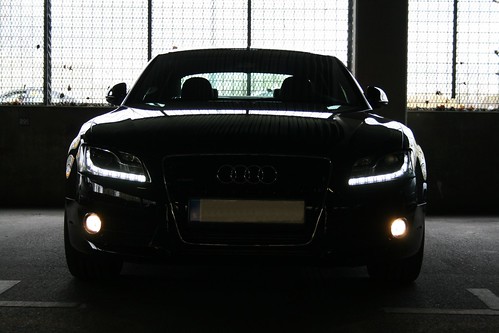
Today I was driving back to my house when I saw a new A4 trailing me. All I can say is that Audi's new take on daytime running lights looks awesome. The strip of LED lights running along the heads are truly menacing in the rear view mirror.

I remember a couple years back when I thought that having the city lights on my Passat where cool, these new lights make my Passat look about as cool as ice cubes. I remember wanting a BMW with Angel-Eye headlamps as well. These Audi lights make all previous efforts look subpar (Saab also uses similar lights that look equally cool)

I want them. As daytime running lights are becoming increasing common (maybe required), I think it is great that Audi is using regulations to make their cars look even better. Unfortunately, something this cool is bound to be copied before I finish writing this blog. Remember how fender vents looked cool on the Range Rover back in 2003? Now we need them just about everywhere. Fortunately LED lights actually do serve some purpose opposed to non-functioning vents.

To Panamera and Beyond..

The recent stratification of the Porsche range into new territory has been controversial. This diversification started with the Cayenne and now includes a new four door sedan/hatchback/crossover(oops), the Panamera. While these latest additions have been engineering feats, stylistically they are about as appeal as genital warts. I recently went through the historical Porsche range, and believe I have found the root and potential solution to the unresolved aesthetic crisis currently afflicting these new striations in the Porsche range; The lack of a front engine design principal.

As Jeremy Clarkson attests, Porsche are the employees the laziest designers in the business. (Other companies have designers that just don't have the right eye) Looking at the 911, it has remained essentially the same since its initial inception in 1963. Even when fresh, this new model borrowed heavily from the 356. The Boxster also draws from the 356 and the Cayman barely deserves to be called anything other than the Boxster Couple. All of these models, have engines behind the driver. (I don't want to argue about the mid verse rear engine/Boxster verse 911 debate because it isn't relevant here). These designs do not call for the standard front engine archetype with a grill and higher hood but rather a low aerodynamic schnoz. 

I do remember the other front engine offerings of the 928/968 etc but these were still low slung sports cars that could "borrow" the predominant design language from the existing models.  I would argue that the 928 is as unresolved as the Panamera or Cayenne, having a rump only a mother could love.  I don't even want to get started on the rear of the Panamera.

Where does this leave these new front engine Porsches? Look at the Cayenne, across the model range, every iteration have a different front grill/intake/bumper assembly much like you see on the 911 range. Do you see BMW changing the shape of their trademark kidney grills between the 328i and 335i? They rely on a design heritage for the model and then tweak other aspects. However, while 911 has a distinct silhouette that can be easily recognized, Porsche has never created a Front Engine Design language. (Maybe because they're lazy) The differences in the bumper correspond to the increasing performance across the range. I think that on a Front Engine vehicle, Porsche needs to develop a standardized grill/bumper design language that can be applied to all models. They can still change aspects to indicator performance. The Lamborghini Estoque concept suffers from a similar problem, yet the angular audacious Lamborghini language seems to adapt better overall. Aston Martin doesn't suffer from this problem because their design language is based on front engine designs. 
 
Porsche is going to struggle with styling until they are able to successfully develop a coherent language for their front engine vehicles. They should look to signature elements in Porsche's history. I would start with the ovaloid grill the the engine cover for the 911, round headlamps, and the intakes from the turbo.

Sunday, February 8, 2009

Acura! Are you guys crazy?


One time my brother and I decided to have a couple friends over to our house. While I had gone to bed, out little gathering, without gaining any new guests, had morphed our house into a dance club. I think everyone was having a great time but the music was too loud and carrying over to the neighbors. The racket only stopped when a friend came in uninvited and screamed, "Are you guys crazy."

Acura has lost its way and is desperately in need of the same savior we had that one night. The directors of product development must have developed amnesia (or suffer from a lack of creativity) because with news of v6 power for the TSX, their range has more overlap than a health car provider. Do the product planners really see a niche for a v6 TSX, when Acura already has their work cut out marketing the new cheese-grater TL. What Acura needs is someone to interrupt the party by screaming; Are you crazy? As we did, Acura will realize they most certainly are.

There is only room for so many similarly equipped front wheel drive cars in a model range. The RL was initially well received, yet has now been usurped by the imposing new TL. This v6 TSX will undoubtably serve as the cast cow, taking buyers from the base TL. This also begs another question, will the 280 estimated horsepower of this new engine be coupled will available AWD, further diminish the need to purchase a TL? I am willing to be so. When you only have three sedans, that all are nearly indistinguishable from on another in features, options, and style, no idiot is going to walk into the showroom and pick the most expensive on to take home. Its like saying here are three coffee machines, they all do the same thing, all are made by the same company, only that one of the left costs half as much as the one on the right. You don't even have to shop around to find a bargain at an Acura dealer now, because the product planners have already done that for you.

The current Acura slogan is "Advance." The million dollar question is where are they advancing? Without RWD, Acura can never be uttered in the same sentence as Lexus, Infiniti or BMW. (Even Cadillac) Right now, it appears the only company Acura appears to be advancing towards is Lincoln. Could Acura be becoming the Lincoln of Japanese automakers? I think so. Look at the similarities between their respective model ranges and their entire corporations. Lincoln has evolved into a Ford trim badge (and with the new Taurus adopting the Kinetic language I wonder if this badge even had any merit). The same much can be said for Acura if you ignore SH-AWD, all the models are based off of FWD platforms with roots in economy cars. Granted Hondas may have a better start to life than Lincolns.  The MDX is a Pilot with a serving plate for a grill and one less seat. The TSX is a Honda Accord (transplanted from Europe), and the TL and RL are both gussied up Accords. With news of the cancellation of the NSX replacement and the RWD RL, it appears that this advance is not going anywhere.

Thursday, January 22, 2009

Fiat and Chrysler: Road to redeption?

Fiat and Chrysler have just announced a strategic alliance. While some critics speculate that alliance is going to be about as successful as the TC by Maserati. I think this could be a perfect match, and any plan that may help bring Alfa and Fiat back more quickly is great and my book.

Let's remember that a couple years ago, Fiat was in a position that some might consider is as dire as Chrysler's. Fiat's sales were declining, production was below capacity, and the products lacked focus and imagination. With money gained from a breakage from GM, Fiat was able to turn around in record time. This sounds very similar to the current crisis at Chrysler. Creating a sequel to their previous success will be difficult, but Fiat does stand a chance to turn Chrysler around.

Looking at this more closely, the pieces of this puzzle appear as though they might fit together. Chrysler is exactly what Fiat needs in the United States in order to ensure a successful resurgence. Currently, Chrysler has an abundance of dealers looking for new products, Fiat and Alfa products fill two niches currently untapped by Chrysler. The entry level cars currently sold by Chrysler are crap. (There is not need to sugarcoat this unfortunate truth). Additionally, since the departure of Mercedes and the DaimlerChrysler breakup, the Chrysler corporation has lacked a premium brand. Alfa could fill the premium void left by Chrysler, and Fiat could provide economical city cars for the United States in addition to platforms for Chysler economy and midsize cars. Fiat could share distribution channels with Chrysler thus minimized the costs associated with creating a dealer network in the United States.

When you start thinking about the potential new models that could be created out of this synergy, it gets even more exciting. The Fiat Panda would serve as the perfect replacement for what the uninspired and undesired Jeep Patriot and Compass were supposed to be. The Chysler LX platform could provide the basic for a new RWD flagship Afla, with the potential for Awd to boot. The PT Crusier could find a replacement with the rebadged Bravo. The opportunities seen endless.

We need to embrace this allegiance and hope for the best or at least hope that in the near future, the Chrysler connection will allow for the reintroduction of affordable Italian cars in the United States.

Friday, January 9, 2009

Cars I want in the United States... NOW!

We all know that in the United States we are not graced by some models or manufacturers. We can be happy we don't get some of them, such as the Perodua Kelisa, or anything from China (except for maybe the Ssangyong Chairman). The following list is several cars that I would seriously consider purchasing if they were sold in the United State. The list consist of several Fords, making me wonder why we have to put up with the crap they try to pass off here. Others are European models where the manufactures do not currently sell here. Finally, we also have the one Japanese model to be politically correct.


Alfa Romeo 159: I first saw this car studying abroad in Australia. With an Italian tuned 3.2 v6, awd, and stunning looks, the 159 makes all other entry-level luxury cars (except for maybe an A4) look dull and uninspired. I keep my fingers crossed for Alfa's return to the United States in hopes that I could purchase this car. We need alternatives to the stoic German offerings when it comes to entry level luxury cars in the United States.

Ford Kuga: Like all Ford's we don't get in the United States, the Kuga looks awesome. I have always though the European "Kinetic" design language looks on par with Jaguars, maybe even Aston Martin. Ok, thats a stretch, but they still look great. With 2 or 4 wheel drive, a diesel engine capable of over 4o mpg, and a manual transmission the Kuga would be a perfect competitor to the comparatively dull Honda CR-V and Toyota RAV4.


Honda Odyssey: I'm not talking about the family version we get here but rather the Japanese version. This car is a minivan/wagon that looks cool. It a better adaptation of the of the Ford Freestyle. Its got a three rows of seats, a four cylinder engine, and urban good looks. I had to include one Asian offering that I thought we should also have the opportunity to purchase.


Fiat 500: With Smart Cars and Minis basically running off dealer lots, bringing the Fiat 500 to the United States with yet another sensible urban car. While the retro looks tag-team on the success of the Mini, the 500 eschews the Mini's overwrought interior with simple yet elegant controls. With a wide variety of engines available, the 500 would appeal to many consumers looking for a fuel efficient city car.


Fiat Panda: Like the Fiat 500 with which the Panda shares its platform, the Panda is a well sized city car. The Panda combines hatchback convenience with cute-ute versatility. Fiat claims that the Panda can hang with true off roaders (like a Range Rover). I appreciate its size, functionality, and features. The Panda proves that economy cars don't have to skimp.

Ford Mondeo: Most American got there first glimpse of the new Mondeo when it had a cameo as James Bond's new whip in Casino Royale. Like other European Fords, the Mondeo features "Kinetic" design language. Having sat in a Mondeo, I feel as though the quality of the interior is on par with modern Volkswagens. It's a shame Ford continues to push its "bold-American" design here.